Distance: 48km
Location: Charlotte Speedway
Date: 18 June, 2023
Up front: I drove two cars, a sixth-generation #15 Toyota Camry and a fifth-generation #46 Chevrolet Impala SS. The older Chevy had a lower belt line so the window was larger and easier to get into. The steering wheel is removable for easy access and the window net stops the driver from falling out in a rollover.
Race cars don’t have any creature comforts. They’re a raw expression of mechanical power and man’s ability to control it. The seats and steering wheel position are fixed to the driver’s height. There is no noise or insulation, the helmet protected my hearing and I burned my right leg on the transmission column.
The gauges just show mechanical information such as oil temperature, water level, and RPM. There is no speedometer. Switches control engine starting and cutoff and there is only one button in the whole car—it’s the steering wheel push to talk button to communicate with your team. There are no side mirrors, only a rear view mirror that is never used because the spotter will tell you what’s going on via the two-way radio.
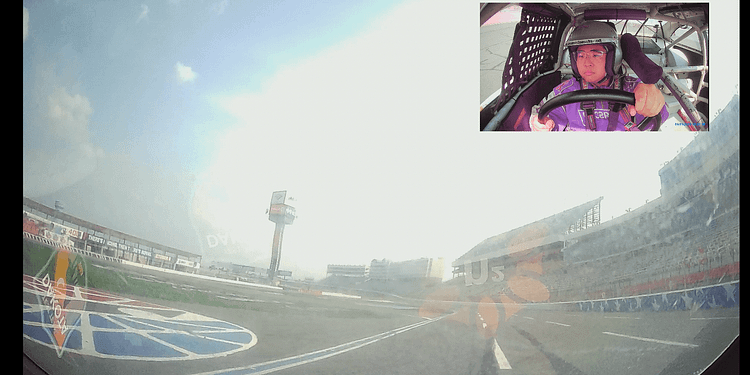
In the back: Nothing. A roll cage and a fire extinguisher.
Driving: The four-speed manual has long vertical throws and short horizontal throws. In both cars, I accidentally started stalled twice because I couldn’t tell between first and third gear. Reverse exists, but is rarely used.
Yes, it’s extremely fast and nothing is powered. No powered brakes, so the driver has to step on it for the brakes to grab. No power steering, so it’s raw muscle power to keep it on track. No traction control, so the driver has to trust the engineering team designed the aerodynamics to keep it on track.
It takes extreme concentration to ensure the car is on the racing line and stays stable at high speed along the bends. Is there an itch on your face? Ignore it. Is your leg burning on the transmission tunnel? Ignore it. Did a bug fly into your mouth? Ignore it. All that matters is staying on the road.