The last time I was in Paris was 12 years ago. I had promised my French friend I’d visit for the last two years, but couldn’t find an economical and comfortable way to do it, so I dutifully collected points for two years before I finally pulled the trigger.
This journey included working around a devaluation, a delay in getting the points I was owed and time constraints.
Air France business class
Brim Financial launched their co-banded Air France/ KLM credit card that accumulates Flying Blue points in October 2022, just as travel picked up. I applied in May 2024 when Brim launched a customer acquisition campaign and offered 60,000 points for spending $15,000. I had to hold the card for two years and pay $132 annual fees (the first year was free). I had told my friend in 2023 that I intended to visit in 2024—that obviously didn’t happen. But she also decided to stay in Madagascar for another year, so that worked out for both sides.
In early 2025, I was optimistic that 100,000 points would get me round-trip business class tickets to Paris. However, Flying Blue devalued their miles by 20% and the offer price was now 120,000 round trip. Plus, the special offers no longer applied to holidays once international travel picked back up, so I would only have enough for one way—from Paris to Ottawa.
By 25 August, 2025, I had accumulated 70,000 points in my Flying Blue account, but I was still missing 30,000 points for the card’s renewal bonus back in May. I was told to wait three weeks for the points to be credited to my account. Three weeks later… nothing. All the while, I was mindful that points and prices for tickets could change at any time as April was only seven months away.
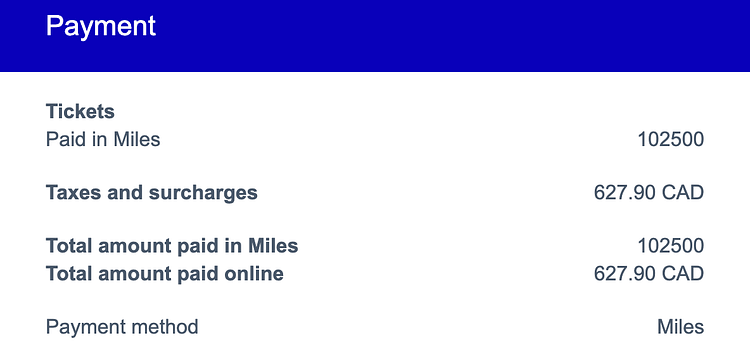
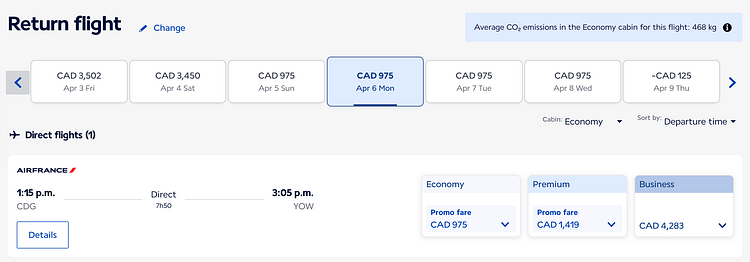
It took another 10 days of phone calls, emails and escalations for Brim and Air France to figure out how to give me the points I was owed, bumping my balance to over 100,000 points. Air France’s cash fare for each way of the flight (on a round-trip basis, as nobody sane would buy two one-way fares in cash) was $4,283. I paid 102,500 in Flying Blue miles plus $628.
I paid the taxes and fees with my Scotiabank American Express Gold card, using $628 in Scene points to offset the entire purchase. The Scene points came from an upgrade offer; I agreed to upgrade from the classic to the gold card and spend $7,500, the bank promised me $750 in bonus points I could use as a statement credit and waived a year of annual fees.
Air Canada business class
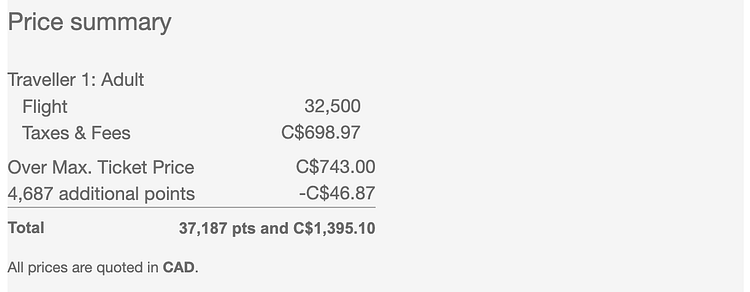
Now that I had my return trip from France sorted, I had to look for an outbound flight. At the time, I held the RBC Avion Visa Infinite Privilege card for about half a year and had 37,000 points left, enough for a one-way flight from Canada to anywhere in Europe. One of the RBC card’s superpowers is the ability to book one-way award flights.
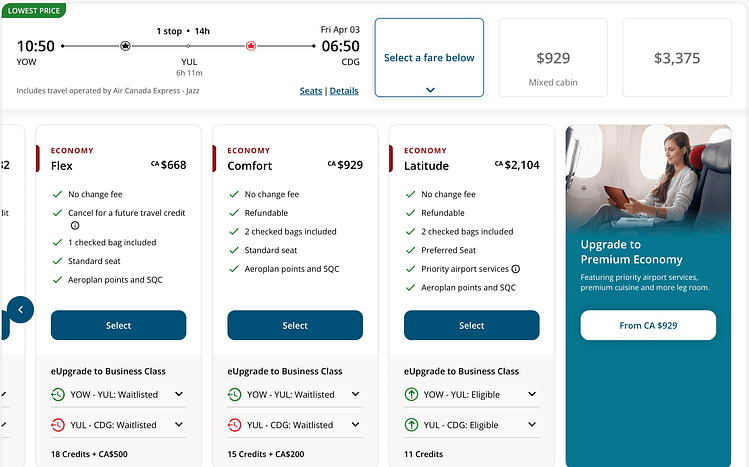
I used my RBC Avion points to lock in a premium economy flexible fare with Air Canada. The fare letme to instantly eUpgrade to business class as I had Aeroplan elite status. The cash fare originally cost $2,104 on Air Canada’s website (on a round-trip basis, again), but only cost me $1,395 after using Avion points and their Expedia discount, saving me $700. The business class fare was $3,375, so the free upgrade saved me more than $1,200.
By flying out on a Thursday evening and returning on Monday afternoon, I didn’t have to take a single day off work. In total, I paid $1,395 (or just the economy flexible fare) for round-trip business class flights, compared to the market price of $7,658, or 82% off.
As for hotels, I used a $200 travel credit from American Express to book a three-star hotel near the Notre Dame (paying another $200 out of pocket to cover the price difference) and 19,500 Marriott Bonvoy points at the airport hotel on Sunday night so I could sleep in before my flight at noon Monday.